Training & Behavior
Obedience Commands & Hand Cues for Poodles
By Marko · November 27, 2023 · Updated September 24, 2026
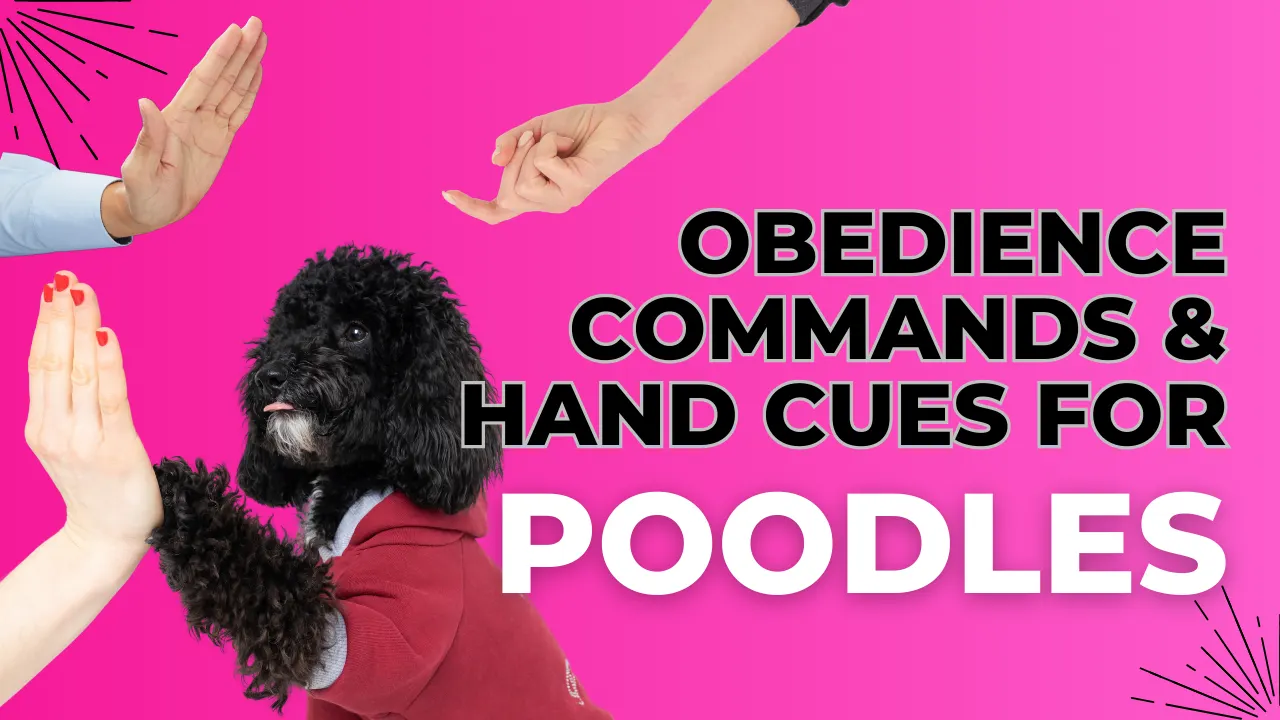
Teaching your poodle obedience commands not only strengthens the bond between you and your poodle but also ensures their safety and well-being.
In this article, I will guide you through essential obedience commands and their corresponding hand cues that work wonders with poodles. Let’s dive in and discover how to communicate effectively with our poodles through these commands.
What Will You Learn?
- Why Teach Obedience Commands and Hand Cues?
- Essential Obedience Commands for Poodles
- Hand Cues for Obedience Commands
- Practice Makes Perfect!
Key Takeaways
- Poodles learn verbal and hand cues quickly, which makes obedience training rewarding.
- Core cues include sit, down, stay, come and leave it.
- Hand cues work at a distance and in noise, where a voice may not carry.
- Teach one cue at a time, and reward consistently.
- Keep sessions short, and practise in different places.
Why Teach Obedience Commands and Hand Cues?
Teaching obedience commands and hand cues to your poodle is beneficial in multiple ways. Here’s why it’s important to invest time and effort in this aspect of training:
- Safety: Obedience commands allow you to control your poodle in various situations, ensuring their safety both indoors and outdoors. They help prevent accidents and keep your poodle out of harm’s way.
- Communication: Establishing a common language through obedience commands and hand cues strengthens the communication between you and your poodle. It creates clarity and understanding, making training sessions and everyday interactions smoother.
- Behavior Management: Obedience commands provide a framework for managing your poodle’s behavior. They help redirect unwanted behaviors and encourage desired actions, leading to a well-behaved and obedient poodle.
- Bonding: Training your poodle with obedience commands and hand cues strengthens the bond between you and your furry companion. It builds trust, respect, and a deeper connection, enhancing your relationship.
Essential Obedience Commands for Poodles
1. Sit
The “sit” command is one of the foundational obedience commands that every poodle should learn. It teaches your poodle to sit on command and wait patiently. Here’s how to teach this command:
- Hold a treat close to your poodle’s nose, and slowly move your hand upwards. Your poodle’s natural response will be to follow the treat, causing them to sit.
- As soon as their bottom touches the ground, say “sit” clearly and give them the treat as a reward.
- Practice this command in different locations and gradually phase out the treat, relying solely on verbal cues and hand signals.
2. Stay
The “stay” command is crucial for keeping your poodle in one place until you give them permission to move. Here’s how to teach this command:
- Start with your poodle in a sitting position.
- Extend your open palm in front of your poodle’s face, palm facing them, and say “stay” firmly.
- Take a step backward while keeping your hand extended. If your poodle stays in place, return to them and reward them with a treat and praise.
- Gradually increase the distance and duration of the “stay” command, always rewarding your poodle for successful stays.
3. Come
The “come” command is crucial for calling your poodle to you, especially in potentially dangerous situations. Here’s how to teach this command:
- Start in a quiet and secure area with minimal distractions.
- Get down to your poodle’s level and open your arms, calling them by their name followed by “come” in an enthusiastic tone.
- If your poodle starts moving towards you, praise them and reward them with a treat.
- Gradually increase the distance between you and your poodle, practicing the “come” command in different environments.
Poodles are quick learners, so they can pick up both spoken and hand cues. Hand signals are useful because they work at a distance and in noisy places where the voice does not carry. Teach one cue at a time, pair the word and the gesture, and reward the correct response every time. Practise in different locations, because a dog that only obeys in the kitchen has not really learned the cue.
Hand Cues for Obedience Commands
In addition to verbal cues, hand signals or hand cues can greatly enhance your poodle’s understanding of obedience commands. Here are some commonly used hand cues for essential obedience commands:
- Sit: Hold your hand up, palm facing upwards, and move it from a low position to a higher position.
- Stay: Extend your hand, palm facing your poodle, and hold it firmly.
- Come: Extend your arm outwards, with your palm facing up, and beckon your poodle towards you.
Remember to pair these hand cues with their corresponding verbal cues to reinforce your poodle’s understanding and response to the commands.
Practice Makes Perfect!
As with any training, consistency and practice are key to success. Here are some tips to make the training process more effective:
- Keep training sessions short and frequent to maintain your poodle’s focus and enthusiasm.
- Use positive reinforcement, such as treats, praise, and play, to reward your poodle for correct responses.
- Gradually increase the level of distractions during training sessions to ensure your poodle can follow commands in different environments.
- Stay patient and understanding, as each poodle learns at their own pace.
Remember, training should always be a positive and enjoyable experience for both you and your poodle. Let’s create a community of poodle lovers who support and learn from each other.
Frequently asked questions
What commands should I teach my poodle?
Start with sit, down, stay, come and leave it. These cover most everyday situations and are a foundation for everything else.
Are hand cues better than verbal commands?
They are useful together. Hand cues work at a distance and in noise, while verbal cues work when the dog cannot see you.
How do I teach hand cues?
Pair the gesture with the word and reward the correct response, then fade the word so the gesture alone works.
How long should obedience sessions be?
Short, around five minutes, several times a day. Poodles learn fast, so brief and frequent beats long and tiring.